
You carefully measure the wall.
You install the anchors.
You hang the picture.
Then you step back and notice the frame still looks crooked.
Most people assume they measured wrong, but that is not always the problem.
Sometimes the real issue is the mounting hardware attached to the back of the item being hung.
Many homeowners assume the mounting hardware was installed correctly by the manufacturer.
That is not always true.
D-rings, sawtooth hangers, wire hangers, keyhole slots, and other types of mounting hardware can be slightly off, loose, bent, or installed unevenly.
The difference may be small:
1/8 inch
1/4 inch
3/8 inch
But once the item is on the wall, that small difference can become very noticeable.
D-rings are a common example.
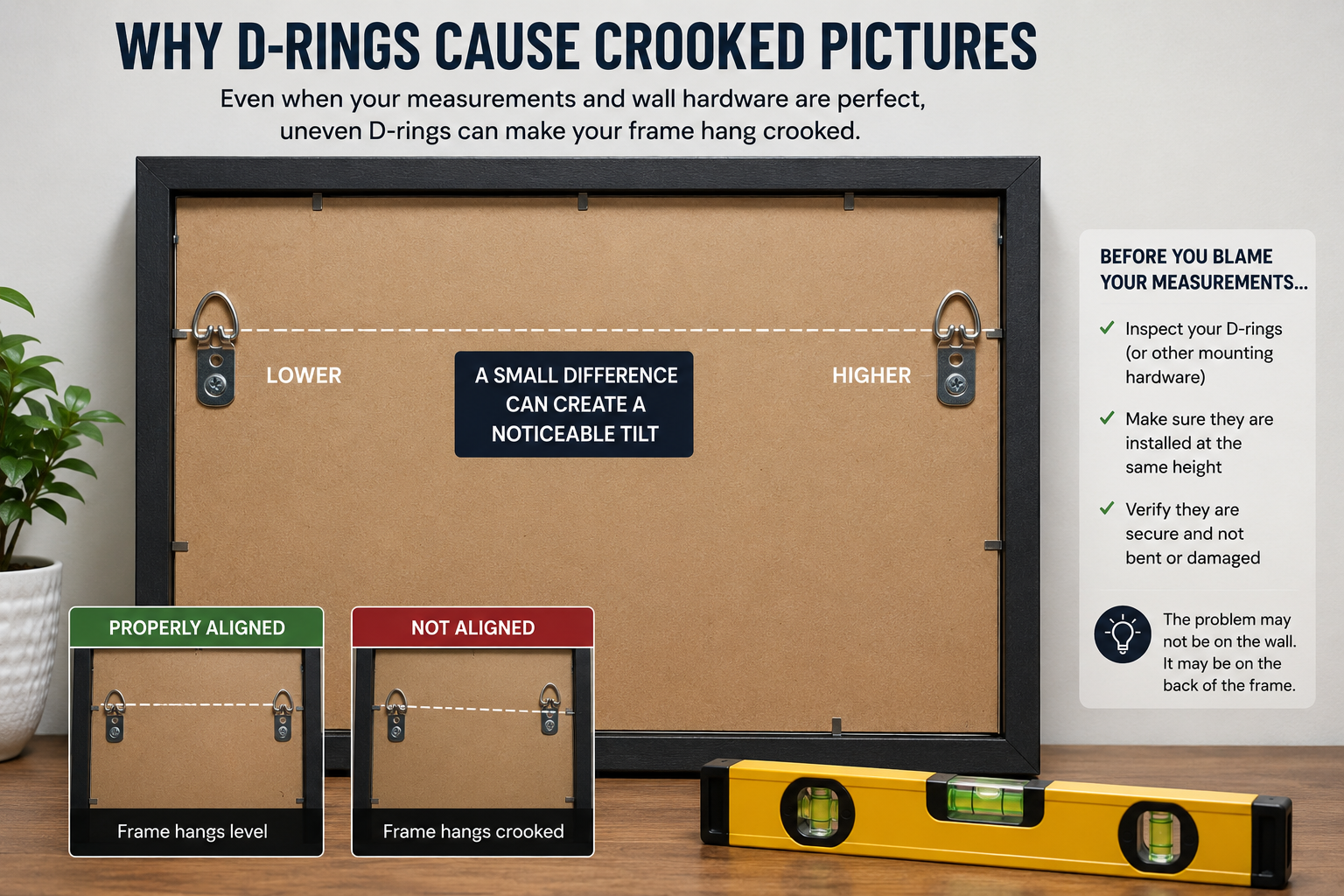
They are small metal loops attached to the back of a frame. When both D-rings are installed at the same height, the frame can hang level.
But if one D-ring is mounted slightly higher or lower than the other, the frame may appear crooked even if the wall anchors are perfectly level.
This is why a picture can look wrong even when your measurements seem correct.
D-rings are not the only hardware that can create problems.
Similar issues can happen with:
The problem may not be on the wall at all.
It may be on the back of the item.
Even if the hardware is not perfect, accurate placement still matters.
You need to know where the mounting points actually are, not where you assume they are.
This is where many mistakes happen.
People often measure from the outside edge of the frame instead of measuring from the actual mounting hardware. If the hardware is off, the wall marks will be off too.
EZ Mount Plus helps transfer mounting locations directly from the item being hung to the wall.
That means you are working from the actual hardware location, not just the frame size or a guessed measurement.
Whether you are hanging a frame with D-rings, a piece with sawtooth hardware, a mirror with keyhole slots, or other wall décor, accurate mounting location transfer can help reduce errors and extra holes.
The goal is simple:
Hang it right the first time.
Continue Reading
Previous Article: How to Choose the Right Wall Anchor for Your Project
Next Article: How High Should You Hang Pictures?