
Few things are more frustrating than hanging a picture, shelf, mirror, or piece of wall décor only to discover the hardware isn’t holding securely.
In many cases, the problem isn’t the object being hung. It’s choosing the wrong wall anchor.
With so many options available at the hardware store, it’s easy to become overwhelmed. Plastic anchors, self-drilling anchors, toggle bolts, molly bolts, and specialty anchors all have their place. The key is understanding which anchor works best for your specific project.
Drywall alone is surprisingly weak.
Without an anchor, a screw installed directly into drywall may loosen over time, especially if the item is bumped, adjusted, or subjected to vibration.
A proper anchor distributes the load over a larger area and helps prevent pullout.
Choosing the right anchor can mean the difference between a secure installation and a damaged wall.
These are the anchors most homeowners recognize.
When the screw is tightened, the anchor expands inside the drywall, creating holding power.
While inexpensive and easy to install, plastic anchors have limited holding strength.
Self-drilling anchors screw directly into drywall without requiring a separate hole.
Many are rated for moderate loads and provide better holding power than standard plastic anchors.
These are often a good choice for general-purpose wall mounting
Toggle bolts use spring-loaded wings that expand behind the drywall.
Once installed, they provide excellent holding strength.
The downside is that larger holes are required during installation.
Molly bolts expand behind the drywall when tightened.
They create a permanent anchor point and provide strong holding power.
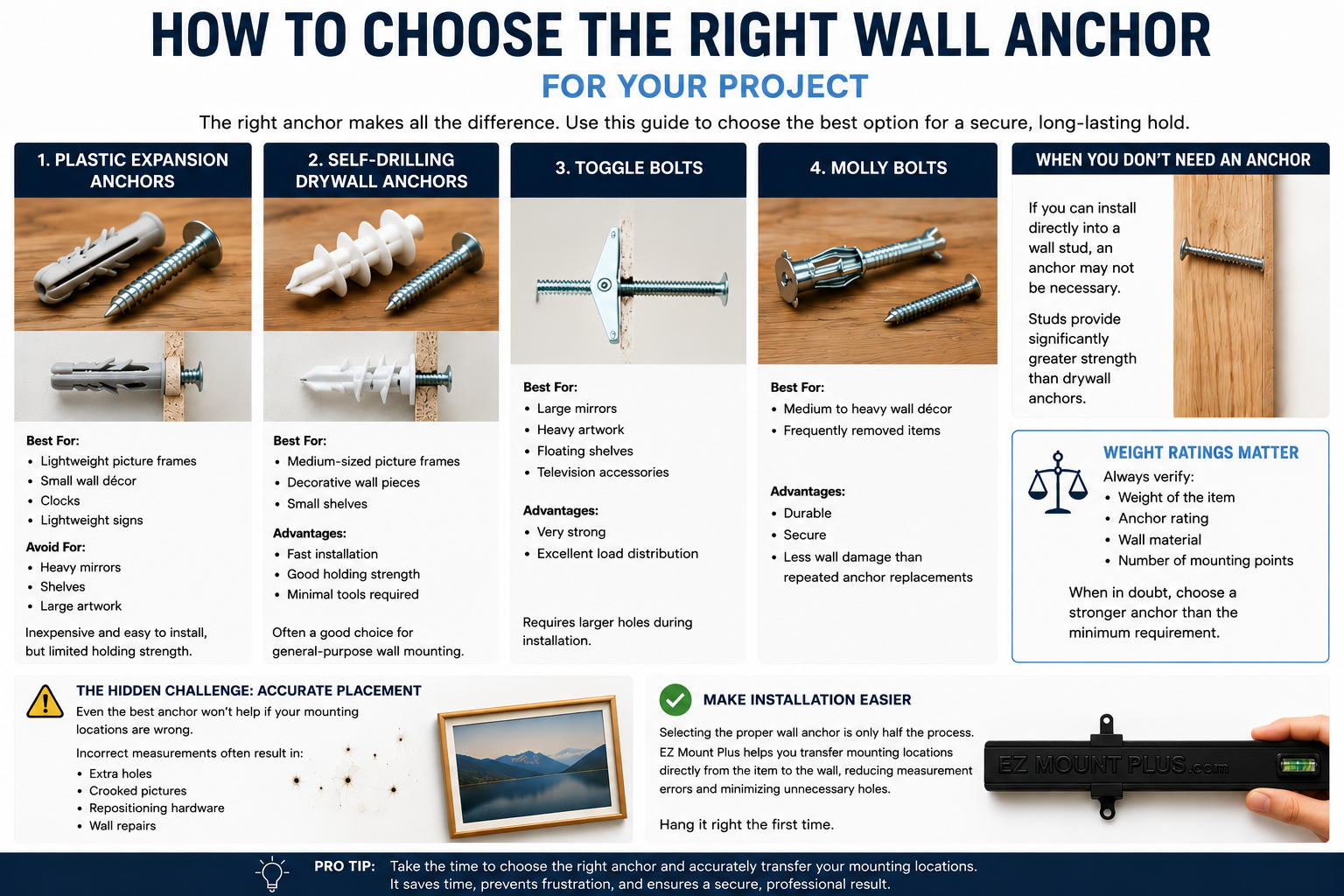
If you can install directly into a wall stud, an anchor may not be necessary.
Studs provide significantly greater strength than drywall anchors.
For heavier items, locating a stud is often the preferred solution whenever possible.
One of the biggest mistakes homeowners make is ignoring weight ratings.
A picture frame may weigh only five pounds, while a large decorative mirror could exceed fifty pounds.
Always verify:
When in doubt, choose a stronger anchor than the minimum requirement.
Even when the correct anchor is selected, installation problems can still occur.
Many homeowners spend more time locating and marking mounting positions than actually installing the anchors themselves.
Incorrect measurements often result in:
The anchor can be perfect, but if the mounting locations are inaccurate, the finished result may still be disappointing.
Selecting the proper wall anchor is only half the process.
The next challenge is accurately transferring the mounting locations from the item being hung to the wall.
EZ Mount Plus was designed to simplify that step by helping transfer mounting locations directly from the item to the wall, reducing measurement errors and minimizing unnecessary holes.
Whether you’re hanging framed artwork, mirrors, shelves, or decorative wall pieces, accurate mounting location transfer can make installation faster and less frustrating.